Flying to the Fisherman’s Town of Kushiro for Birdwatching and Hiking Expeditions (Part 2)

Hiking to the base of Mt. Io where volcanic gases spew from vents.

After a lovely first evening of exploring the central streets of Kushiro and having a whole rental apartment complex to myself, the next I departed on a full day bus tour to all of the major sightseeing points of this area. The White Pirika Bus I selected for this trip runs from January – March and will take you on a journey to see rare species of birds, famous lakes and mountains, and hot springs too! I really recommend this tour because I was able to see everything I wanted and it was cheaper than renting a car. The guides only speak Japanese, but will show you the best spots for birdwatching and hiking so you know exactly where to go without wasting any time. As someone who loves photography and listening to guides to practice Japanese, this was the optimal tour for me. I would advise booking this tour at least a week in advance online because it has limited availability.

The major spots that are covered in this tour are: Tsurumidai (for viewing the cranes), Sunayu (for viewing the swans), Mt. Io, Lake Mashu, and Lake Akan Hot Springs

Afterwards you can request to be dropped of at Kushiro Station, Kushiro Airport, or your accommodation.

If you come during the warmer seasons to Kushiro, you can reserve similar buses on the Akan Bus website, but the swans and cranes rarely appear. I recommend coming here during the winter because you can do and see the most!

Tsurumidai

The very first place we stopped on our tour was Tsurumidai, which is a popular lookout spot for the Japanese Red-crowned Crane (also known as the “Japanese Tanchou”). The Red-crowned Crane is one of the largest East Asian cranes and one of the rarest species of crane in the world. This bird is said to bring good luck and is a prominent symbol in many folklore and legends. It also appears in Japan Airlines’ logo! I enjoyed watching these cranes spread their wings and honk at one another. They seemed completely unbaffled by the presence of so many humans watching them from the other side of the fence. They were a lot bigger than I had initially anticipated, and that made watching them all the more fun. After March they usually migrate to other countries such as Russia and China. I was extremely lucky to catch sight of them this year!

Sunayu

The next stop of this tour was at Sunayu, which is a hot spring that oozes out of the sand for both humans and birds! Sunayu is located on the east side of Lake Kussharo, and is a popular campsite during the warmer months. During the winter, whooper swans flock to the warm waters for comfort and a number of people come to watch them. A few years ago, a group of my Japanese friends came here for photography and one of them created this melodic track called “Whooper Song” that was inspired by the sight of the whooper swan. Since then I wanted to come to Kushiro and see the bird for myself, so I’m extremely grateful I had this opportunity!

Here are more photos I took of the beautiful whooper swans. They truly are serene:

Mt. Io

Our third and perhaps most adventurous stop was at Mt. Io, which is an active volcano in Kushiro. It is famous for erupting sulfur and volcanic gases from its vents, and has a lot of characteristic geological formations. Climbing is prohibited, but you can hike up to the fenced area and get extremely close to the vents. I watched a Japanese couple stick their hands into the fumes and was concerned they were going to get burned, but it is safe to do this at the base! I tried it myself and found that the temperature was comfortably warm; kind of like a steam sauna. You can buy eggs cooked by the steam at the souvenir shop which I highly recommend, because they are healthy and delicious!

Lake Mashu

Our next destination was a brief stop at Lake Mashu, which is a caldera lake formed by an active volcano in Akan Mashu National Park. It has been called “the clearest lake in the world” and is considered Japan’s post beautiful lake. It is also one of the deepest lakes in this country. Visitors are not allowed to go down to the lake, but can view it from multiple observatories. I was thankful to have the tour guide here to point me in the right direction of to where to take the best pictures. Its waters truly were beautiful and reflected the surrounding winter scenery.

Lake Akan Hot Springs (and Lunch)

Our last stop was at Lake Akan Hot Springs where we were given an hour of free time to do whatever we wanted. Here you can choose to ride a banana boat, rent winter sports equipment, go shopping, or bathe in a hot spring bath. If you know me, you know I love hot springs so I naturally went to the nearest one at a hotel adjacent to the bus stop. The entrance fee was only 1000 yen and it included a towel and shampoo. I had the whole outdoor bath to myself so that was a plus! It felt so good to clean up after all the hiking I did this day. I also walked around the hot spring town and looked at the little shops. I enjoyed seeing all of the wood carving places and cafes, but unfortunately not a lot of things were open. I did enjoy how private this area was though; there was hardly anyone here except for our tour group and that was nice!

Right before this stop we were given a delicious bento lunch that contained fish or meat (I chose fish), and I ordered hojicha gelato for dessert. All of the food in Hokkaido is cheap and tastes amazing so you really can’t go wrong with what you eat here!

Final Thoughts

Overall this was one of the best tours I’ve ever been on in Japan because not only did it include lunch and entrance fees to all of the parks, but it also took me to every single place I wanted to see in Kushiro! I had a fantastic time seeing the birds, active volcanoes, and lakes this part of Hokkaido had to offer⁠—not to mention the hot springs! I feel extremely fulfilled to cross yet another dream destination off my list. I would recommend Kushiro to travelers who have already seen all of the major cities of Hokkaido and are looking for something more secluded and unique. I hope to come back to Hokkaido again during the summer for some more photography, because this island has a lot of untouched nature and exciting places to see. I feel so relaxed after getting out of the city for a while too!

Thank you for reading my Kushiro article series. I plan on going to Nara this year to see the cherry blossoms, and possibly Shimane and Yamaguchi too if I have time. Please expect more exciting articles from me!

Flying to the Fisherman’s Town of Kushiro for Birdwatching and Hiking Expeditions (Part 1)

Rare appearance of Whooper Swans at Sunayu in Kushiro, Hokkaido.

Earlier this week I flew to the small fishing village of Kushiro, Hokkaido, to live out my birdwatching dreams and see rare species that are exclusive to Japan and only gather during the early winter months. I have been to Hokkaido 4 times now (three times during the winter and once during the summer), and was happy to return since my last trip to the Lavender Fields of Furano. Kushiro is known for its delicious seafood, beautiful birds, and volcanic mountains with scenic lakes. There are various hot spring towns that surround the bases of the mountains attracting a number of tourists from outside of town each year. You can also partake in winter sports at Lake Akan which has rental gear during this season.

Overall I would describe Kushiro as a secluded getaway with many areas to hike through and enjoy year round. It was a much needed vacation from my crazy city life, and after completing this expedition I feel much more at ease and can think clearly now.

I would recommend Kushiro to those who have already seen the major cities of Hokkaido (such as Sapporo, Hakodate, and Otaru) and are looking for something different. This is definitely more of a remote area, so be prepared to travel a lot! Fortunately I have prepared a cost-efficient itinerary on how to best see Kushiro in two days without a car.

Getting to Kushiro from Tokyo

The best way to get to Kushiro is to fly directly to Kushiro Airport. The average cost of roundtrip tickets from Haneda Airport to Kushiro Airport is around 30,000 yen and takes about 1.5 hours. You can also take the train from Sapporo Station if you’re already in Hokkaido, but it takes over 4 hours and costs around 20,000 yen. Flying will save you a lot of time and stress, so I recommend looking for deals through Peach Aviation.

This time I decided to go with AIRDO Airlines because their flight schedule best fit my work schedule. My flight was very smooth, and my flight attendant noticed I had my Switch and Hisuin Growlithe plush with me so she gave me a free Pokemon postcard! This was truly exceptional service. I also enjoyed flying into the sunset on this trip and seeing all of the vibrant colors:

As you can see from the map, Hokkaido is close to Sakhalin, which is the largest island of Russia. At one time you could travel to Sakhalin by a five-hour ferry from Wakkanai, which is a port town at the tip of Hokkaido. For more information, see this writeup from Time Out Tokyo.

In 2018, there were discussions about the construction of a bridge from Hokkaido to Sakhalin that would connect Japan to Russia. I remember hearing about this in the news and thinking it was an interesting idea at the time, but the construction never happened (maybe for the better). With the way the world news is now, it’s truly shocking to believe that it was ever even a concept. My heart goes out to all of my friends in Europe and I hope for the safety of Ukraine.

Exploring Kushiro’s Main Street: Kita Odori

I arrived to Kushiro airport around 17:00, and took the Airport Limousine bus to the center of the city for 950 yen. The ride took around an hour and I couldn’t see much outside of my window because it was already pitch black. There was snow on the ground, but the temperature of Kushiro in March wasn’t really any different of how Michigan, my home town, is during this time of year. I would definitely recommend bringing warm clothes, a hat, and gloves, though! During summers in Kushiro, the snow completely melts and the temperature is more mild. However, I wanted to come in the winter specifically so I could see the rare types of birds that flock here.

After my bus arrived at Kushiro Station, the first thing I decided to do was eat some delicious seafood donburi which Hokkaido is famous for. I looked up a restaurant called 釧ちゃん食堂 釧路本店 that had phenomenal reviews so I took a 10 minute cab ride there and prepared to chow down. Trust me, I was not disappointed because I bought this huge bowl of fresh fish for only 2200 yen. The crab, sea urchin, and squid tasted so fresh and there were huge slabs of other fish included in this assortment too:

Address: 〒088-0623 Hokkaido, Kushiro District, Kushiro, Kowa, 4−11 2F

Another place where you can get delicious seafood is Kushiro Fisherman’s Wharf MOO which is right near the station, but it closes at 17:00 so be sure to get there early!

After filling my stomach and feeling completely satisfied, I decided to go to hot spring on top of a hotel called Paco Kushiro. This was within walking distance of my accommodation (see further below) and only cost 1000 yen to enter. It had a sauna, multiple spa baths, and an open air bath on the 12th floor that was perhaps the steamiest hot spring I had ever entered due to the cold temperature. I couldn’t take any pictures because it was public, but it greatly relieved my fatigue so I can’t recommend it enough!

When I awoke the next morning, I decided to go on a 4 mile run to get more acquainted with Kita Odori and the surrounding area. I first ran to Itsukushima Shrine, which was about a mile from my hotel. This is one of the biggest shrines in the area and is definitely worth checking out if you’re interested in them. I also passed by Yonemachi Park that had a lighthouse as a famous landmark. On my way back I stumbled upon Grace Church near the station. This is a tourist destination that also serves as a wedding hall, but I have seen many churches in the US so I wasn’t particularly interested in it. There was also a police station that had signs in Russian. The further north you go in Hokkaido, the more of this you will see!

After finishing my run, I decided to take a tour through the White Pirika bus company to see the major sights of Kushiro. I will be detailing and reviewing my experience in my next article!

Accommodation

This time I chose to stay in a brand new apartment complex called Kamuy Rera that is close to Kushiro Station. The average cost of single rooms is 4500 per night, but this is one of the nicest places I’ve ever stayed at and I was the only guest there! It was great having an entire lounge to myself, plus all of the rooms were equipped with powerful heaters. In the past, sometimes I’ve made mistakes of staying in guest houses that aren’t insulated very well and have had trouble sleeping. However, I slept like a baby here and was ready for a full day of hiking the next morning. I would recommend staying here because it is centrally located and very quiet.

This concludes my introductory article of “Cool” Kushiro. In my next article, I will be writing in-depth about the unique species of birds in Kushiro and where to find them, plus my recommended hiking areas. Please look forward to my future adventures, because I have a lot planned this year!

A Yuru Camp-inspired Trip to Yamanashi: Fujiyoshida (Part 1)

Just west of Tokyo lies the scenic Yamanashi Prefecture—home of Mt. Fuji and its famous amusement park, Fuji-Q Highland, that holds a several world records for its thrilling roller coasters. After climbing the mountain during my first summer in Japan and visiting the theme park a few months later, I thought I had seen everything this prefecture had to offer. However, after watching the comfy camping anime Yuru Camp (localized as “Laid-Back Camp”), I realized that there were many amazing places I had overlooked. Aside from Mt. Fuji, Yamanashi has beautiful campsites by the lake, hiking trails, kind locals, and an abundance of delicious food too!

In the first season of the anime, Shima Rin, the main protagonist of Yuru Camp, explores several campsites around Fujiyoshida on her scooter and meets other interesting characters through her adventures. In later episodes she explores the surrounding prefectures of Nagano and Shizuoka which I have both traveled to for music events so seeing them featured in the anime felt nostalgic. Though she prefers traveling alone, she eventually realizes that group camping can be extremely fun and rewarding. I relate to this feeling in many ways. Through the anime I have learned a lot of random facts about Japan and discovered a number of destinations I would like to travel to which is why it is one of my favorite series. I recommend it to everyone as it is extremely relaxing to watch!

Over the past weekend I decided to plan a three day trip to Yamanashi to see some of the spots mentioned in Yuru Camp and also meet up with some friends that live near Kofu Station. I decided to spend the first day sightseeing in Fujiyoshida solo so I could get acquainted with the area (Shima Rin style), then take the local train to Kofu and see my friends the next two days. This turned out to be a phenomenal idea because I was able to cover a lot of ground with the help of a kind local and my friends who own two cars. Though it is definitely possible to see Yamanashi by local train and bus, having a car is nice to reach the hiking trails and waterfalls.

Getting to Yamanashi (Shimoyoshida Station)

Since Yamanashi is the prefecture directly west of Tokyo, there are a number of ways to travel there by both train and bus. Because I am a pretty spontaneous person, I decided to hop on the local trains around 10am because they are pretty cheap and require no reservation. I rode the Chuo Line to Takao Station, then transferred on the same line to Otsuki Station where I took the Fujikyuko Line to Shimoyoshida Station. This journey took roughly 2 hours and cost under 2400 yen. This is nothing compared to the price of taking the shinkansen to Kyoto or Osaka!

You can also look into booking a bus ticket from Fuji Express or purchase one at the Shinjuku Bus Station if you don’t want to deal with transfers. These are around the same price as the trains but may be cheaper if you book them in advance.

Kofu Station is another popular destination in Yamanashi which I will be covering in my next article. Shimoyoshida Station is closer to the Five Fuji Lakes and Fuji-Q Highland which is why I came here first. It also is a great are for viewing sakura in the spring.

Trying Curry at “Little Robot”

As I usually do my morning workout before I travel anywhere so I can enjoy my food guilt-free, I was quite peckish when I arrived at Shimoyoshida Station. I decided to walk to a vegetarian-friendly curry restaurant called Little Robot that was 8 minutes down the road. Here they have delicious Indian curry sets for both veggie and meat lovers as well as vegan desserts. I tried a vegetable lunch set that had 3 mild curries, lightly fried vegetables, and a healthy portion of yellow rice. The combination of spices here was simply amazing and it gave me the energy I needed for hiking! I also ordered the vegan coconut balls because I was curious what they tasted like. Once again, they were powdered to perfection and you could tell that they were baked with love.

The owner and waitress were super friendly and invited me to a yoga class at their restaurant that night, but unfortunately I did not have time to go. However iff I come back here in the future to see the sakura, I would love to come! Yamanashi people definitely have a reputation for being genuinely friendly which I’ll get into under my next heading…

Chureito Pagoda

Out of all the places in Fujiyoshida, the Chureito Pagoda observation deck is one of the most iconic viewpoints in the city. Unfortunately since I came here in February there were no sakura or red leaves on the tress, but during the late spring and early fall seasons this area is picture perfect. The best thing is regardless of the time of year you can get the perfect view of Fuji up here. The hike is roughly 25 mins from Fujiyoshida Station and is fortunately a leisurely one. This pagoda is located in Arakurayama Sengen Park and has several trails and gardens you can see as well.

As I was setting up my tripod to take pictures, an older Yamanashi local approached me a started a conversation with me. He asked me the usual questions I get daily like where I was from, what I like about Japan, etc., then offered to drive me around the area. Since I saw him talking with other people around me and thought he was trustworthy, I took him up on his offer because there were a number of places that I wanted to see. This wasn’t the first time I hitch-hiked around rural Japan, anyway, and I was down for the adventure.

Kaneyamano Falls

Though Kaneyamano Falls haven’t been featured in Yuru Camp yet, they were still a destination that I really wanted to check out. Luckily they are a simple 15 minute drive from the pagoda and a 3 minute walk from the parking lot. To be honest I was expecting more of a hike to reach them, but they weren’t disappointing in the slightest and I got my hiking in later. Seeing a waterfall during the winter is a beautiful experience. In February there is not as much snow in the Fujiyoshida area, but the tiny patches of it lingering around the falls made it a wonderful spot for photography.

Local Shrines

As most Japanese guides are quite fond of showing tourists their local shrines, I couldn’t turn down my driver’s enthusiastic proposal to see Kitaguchi-hongu Fuji Sengen Shrine and Arayayama Shrine. I was impressed with the beautiful pine forest that lined the entrance to Sengen Shrine. Since we came here on a quiet Friday afternoon there weren’t many people here and we could enjoy our time here in peace. Both of these shrines are close to the falls and are easily reachable by car or local bus.

Lake Yamanaka

I woke up at 6am this morning to watch episode 5 of the currently airing Yuru Camp Season 2 before I departed, and was thrilled to see that they featured Lake Yamanaka near where I booked my hotel. This scenic lake is simply a 10-15 min drive from central Fujiyoshida and is absolutely breathtaking to see. I came in the afternoon and the sun was shining creating a beautiful sparkling effect over the water. This was pure bliss.

Here is a screenshot of Lake Yamanaka the anime which accurately depicts the patches of snow that I saw around the lake:

The anime version of Lake Yamanaka.
The real thing looks almost better than anime.

In the summer I would consider camping here so I could see the beautiful sakura around this area and the Fuji Five Lakes. In the winter I would recommend staying in a hotel or ryokan because the chill is simply too cold. Please see my recommendations at the bottom of this article.

Oshino Hakkai

Oshino Hakkai is a small village with interesting architecture that is just a short 10 minute drive from the aforementioned shrines and lake. It has 8 ponds and of course a clear view of Fuji year-round making it a popular destination. Unfortunately most of the vendors were closed for the winter, but we had fun walking across the bridge and seeing the koi swim in the pond. The roofs of the houses here reminded me of Shirakawago and were fun to see. The building structure in Yamanashi is definitely more exciting than houses found in Saitama or Chiba surrounding Tokyo.

Traveling during the off-season definitely means less is open, but you have the whole place to yourself which is the best!

After doing photography at all of these destinations I was fully satisfied and politely asked to be returned to my hotel. My driver kindly bought me chocolate bread and wine from Family Mart and dropped me off. What an amazing day, and this was only the 1/3 of the entire trip!

Accommodations

There are a number of affordable ryokan and hotels in this area, but if you are a backpacker like me then I definitely recommend staying at a guest house because it has everything you need. I chose Fuji Hostel YOU and got a private twin bedroom all to myself for 3200 yen per night. This guesthouse is located between Fujiyoshida Station and Mt. Fuji Station and has plenty of restaurants and convenience stores around it so it was the perfect choice for me. I would gladly recommend it to all of my friends.

Overall, Fujiyoshida is simply remarkable because you can see Fuji from anywhere you look. You can access Fuji-Q Highland and many beautiful parks and trails while feeling extremely close to the mountain in the heart of Japan. If you are a nature enthusiast then you cannot simply pass this place up. It’s crazy that it’s taken me this long to explore this area, but better late than never. I am happy that anime inspired me to travel here.

In my next article I will be writing about Minobu and Kofu—two areas in Yamanashi that are frequently referenced in Yuru Camp. Please look forward to my continued anime-inspired adventures through Fuji Town!

Living Life the Way it’s Supposed to be Lived (Onsen Trip to Nagano, Japan)

Snow falls gently on Lake Nojiri in Nagano creating a a picturesque winter scene.

Right before the second emergency state for Tokyo and surrounding areas was declared on January 7th, a number of business owners gathered in Nagano Prefecture to discuss what would become of their once booming industry that has rapidly declined this year due to the effect of the corona virus. According to a friend of mine who owns several ski resorts and ryokan in this area, they are currently only at 1/4 capacity this year. Usually Nagano is one of the most popular areas to do winter sports because it is easily accessible by shinkansen and has many hot springs where you can spend the night. It was also where the 1998 Winter Olympics were hosted and is famous for its snow monkeys which normally draw in a number of visitors from around the world each year. According to the Foreign Press Center, Nagano has surpassed Okinawa for having the longest life expectancy in Japan of above 80 years for both men and woman. Seeing the local tourism drop in such a boisterous place is a fatal blow to the nation, but also can’t be helped in this situation.

Though this is a tough time for everyone, currently many people in Nagano are strategizing what they can to keep their businesses alive. My friend who I met through writing articles online invited me to Nagano right before signing the contract to close one of their hotels for a final celebration. This became a two day trip that was completely sponsored and I am very fortunate that I was able to travel here so spontaneously. I previously traveled to Nagano in 2018 and saw the snow monkeys as well as an indie music show in Matsumoto, but I’ve never stayed at a ryokan here. Like the ryokan in Nara that I stayed at during my last sponsored motorcycle trip, this one did not disappoint!

Getting to Nagano

From Tokyo Station, Nagano Station is only 1 hour and 20 mins away and only costs 8340 yen to ride the Hokuriku Shinkansen there. This is less hassle than going all the way to Kyoto or Osaka. I was initially worried about traveling here due to heavy snowfall last weekend and almost cancelled my trip, but my friend assured me that the snow was further north by Toyama and my trains from Tokyo would not be affected. I left around 9:30am and made it to Nagano Station by 11:30am. The trip was peaceful because I mostly slept on the train and drank a cup of umeshu from Ueno for a buzz when I woke up. Since I didn’t travel during the New Year’s holiday, this was my first major trip of 2021 and it was sure a memorable one!

Lunch at Hotel Metropolitan Nagano

Just as I arrived to Nagano Station, my friend was waiting for me in the parking lot with their car. The temperature was definitely chilly but not as cold as I had expected. I was happy to see the vast view of the snowy mountains but was also starving. Fortunately my friend was hungry too so after exchanging quick greetings we drove to Hotel Metropolitan Nagano and had a delicious lunch set at Shinano. I ordered a balance of sashimi, rice, tempura, and vegetables and has some delicious miso soup to warm me up. I loved the decorative dishes and the wine they had on display here. Already I was proud of myself for braving through the snow and making it here because the food was worth it!

Exploring Lake Nojiri

Since our ryokan checkin time was at 15:00, we had around 3 hours to kill. We decided to drive around Lake Nojiri since it was on the way to the onsen. Though the area around Nagano Station was mostly just frosty, we were surprised to see thick layers of snow piling up just 5km away on the forest roads. Fortunately my friend had a lot of experience driving here so it was not a problem. Once we arrived at the lake, we got out of the car to do some photography. There was a beautiful island in the middle of the lake that gleamed in the gentle sunlight. There were also little log cabins in clusters on the edge of the lake. My friend informed me that this area was called “Gaijin Mura” because foreign missionaries have owned property and have lived here for over 100 years. According to Outdoor Japan, they have managed to protect the place from “bubble-era developers” so this is actually a good thing. This area already has a number of resorts so it’s refreshing to see this atmosphere. You can rent cabins here year-round which sounds like an awesome to do in the summer!

I remember a while ago one of my Japanese friends traveled to this area and called it “雪の国” on Twitter. With all of the snow flurries around I can definitely see the reference to “Snow Kingdom” in Mario Odyssey!

Arriving at Onsen Paradise (Yorozuya)

After driving around Lake Nojiri in its entirety, we arrived to our ryokan, Yorozuya, around 15:30 and immediately went to the public outdoor hot springs since they are the largest and have the best scenery. We decided to use the smaller private ones at night after dinner. I had previously looked on Booking and other Japanese sites for ryokan deals, but could have never imagined staying somewhere so beautiful. My friend actually found this deal through a local travel agency in Nagano by going there in person. All of the rooms had their own custom design and were equipped with a kotatsu (which I slept under), yukata, amenities, and premium room service. It had been half a year since I had stayed in one of these room so I was beyond excited. I will be sure to consult with Japanese travel agencies in the future because this was for sure a better place than anywhere I looked at online. I felt fully relaxed and welcome during my stay so I would rate Yorozuya 5 stars.

Address: 〒381-0401 Nagano, Shimotakai District, Yamanochi, Hirao, 3137

Dinner with a Hint of Gold

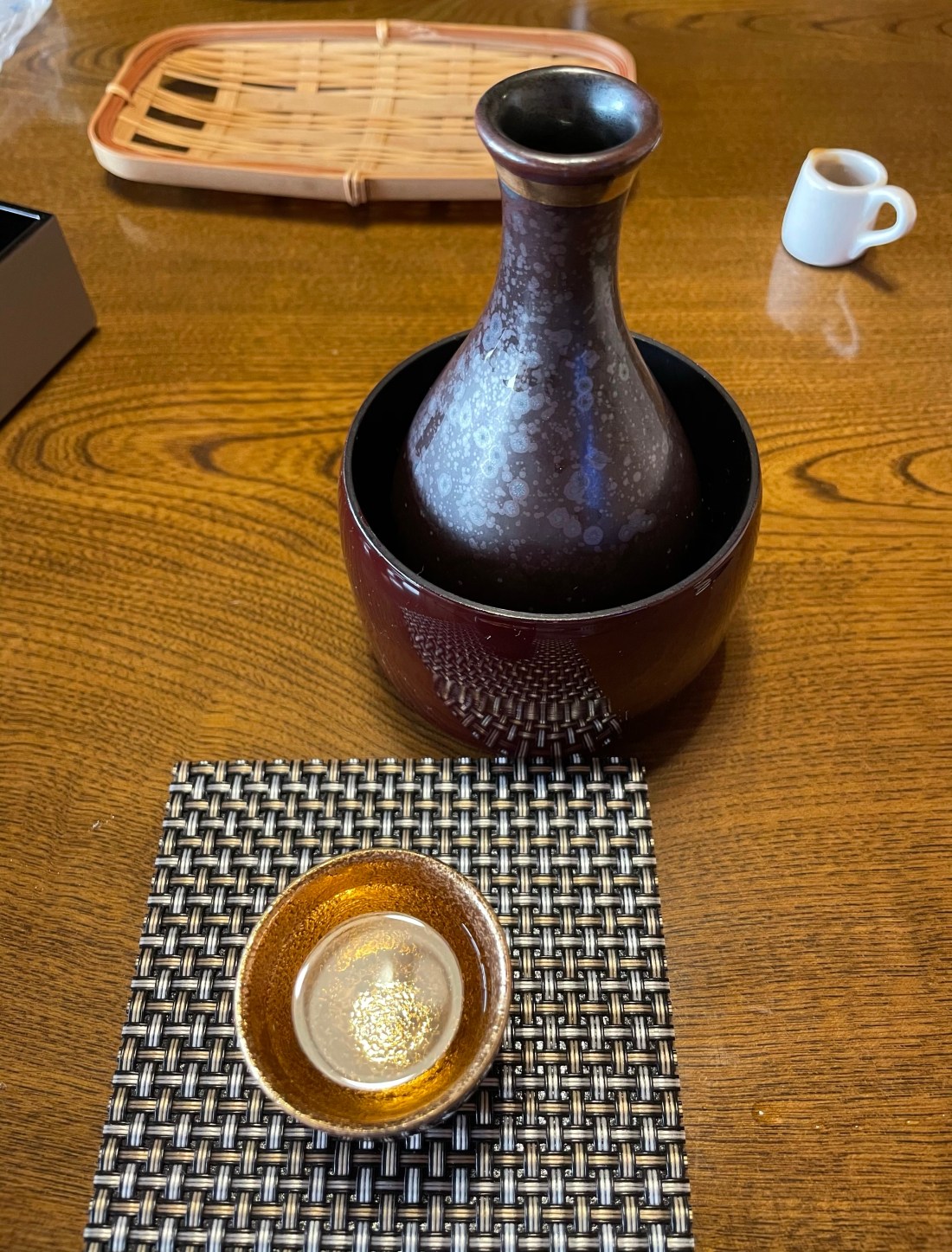
After fully relaxing at the indoor and outdoor hot springs, we sat down for our dinner at around 18:30. This wasn’t my first time going to an onsen during winter, but seeing the snow fall from sky while the steam rises up from the water was definitely a sight to behold. Plus I already had a decent buzz going on from the sake and apple wine that I ordered for our room so I was in a really good mood!

An immaculate course dinner was served with an explanation before each dish by the kind waitress and I was amazed to find that there were real flakes of gold in my food! I think the seared fish, sashimi, and mushroom hot pot were my favorites but all of these dishes tasted out of this world. Dessert was light fruit and green tea-flavored pudding. Plus another round of nihonshu requested by yours truly! And there was a tiny serve-yourself bar in the basement of the ryokan. What more could you ask for in life? The view of the snowy mountain tops from the window topped it off.

Private Onsen

Since the outdoor bath in our room was frozen due to cold temperatures, the Yorozuya staff graciously offered us a free shuttle service to a nearby onsen where we could use private baths after dinner. There we found a steamy indoor bath filled with apples and an outdoor one decorated with bamboo and an umbrella. Since these baths were completely private, photography was allowed. This was the moment I had been waiting for!!

Final Thoughts

This trip is exactly what I needed to get 2021 off to the right start and set my mind free. I did not travel during the winter holiday because many places were affected by COVID-19 and I wanted to prioritize work and saving money. I have been bummed that I still haven’t been able to travel to the Philippines or Indonesia like I had planned to last year, but this trip reminded me that it’s really important to focus on self-care and that nature can be enjoyed in its simplicity. I graciously thank all of my friends here for taking care of me because I don’t know when it will be safe to visit America again. However, I am very happy with my life now and am also close to reaching one of my major financial goals this month so I plan to continue at this pace for now. I have faith that things will get better with time and that I will be able to meet my friends and family with a smiling face one day again. In the meantime, I’ll be playing FFXIV and giving my all to my current line of work.

What does this mean for the future of small Japanese businesses though? From my personal example I found it interesting that two ryokan were working together to ensure that all facilities were available to their customers. Perhaps these businesses can continue to rely on one another and also local travel agencies to keep their businesses alive. Though I definitely noticed less people here, I did not sense a complete loss of hope. Cuts and sacrifices will need to be made in order to survive these hard times, but as this culture has demonstrated many times, perseverance can go a long way.

Adventures in Nikko: Waterfalls, Igloos, and Walking in an Edo Wonderland

27750607_10213770949059358_4463311580879202149_n
The snow on the mountains behind Nikko Station give it a scenic winter look.

Yesterday I wrote about the popular mountainous hotspring getaway Hakone, so today I’m writing about Tokyo’s other most popular day trip: Nikko in Tochigi Prefecture. Like Hakone, Nikko is also a famous hotsprings area located in the mountains that has stunning nature, temples, and a lot of parks as well.  Between the two of them, Hakone is my favorite because the hotsprings and museums are easier to reach by bus.  Nikko is more spaced-out than Hakone and some of the hot springs take over two hours via bus to reach.  That is a lot of traveling to do if you’re just coming for the day, but if you really like hiking you may find Nikko more interesting.  Both are worth seeing at least once.

I’ve been to Nikko twice (once in the summer and once in the winter for the snow festival) so I will be detailing my favorite discoveries in this article.  All of these places can be reached via bus from Nikko Station:

Kegon Falls & Toshogu Shrine

Kegon Falls is one of the most gorgeous waterfalls in Tochigi Prefecture.  It was formed by lava that rerouted a river into Lake Chuzenji.  We came here in the dead of winter when the surrounding area was covered by snow and slightly frozen, but the waterfall was still freely falling from the mountains.  I will never forget how beautiful this scenery was.  No matter what time of year you visit you will have an unforgettable view!

In the summer I visited Nikko’s most famous shrine: Toshogu.  This is a UNESCO World Heritage Site for a good reason.  This shrine serves as remembrance for Tokugawa Ieyasu who ruled the Tokugawa Shogunate for over 200 years.  This shrine complex consists of several buildings with the main one being adorned in golden architecture that gleams in the sunlight.  The shrines are located in a forested area so visiting each of them is quite a nice hike.  I’m glad that I’ve traveled here during both the summer and winter so I can see the lovely change of scenery.

Kegon Falls has no admission fees, but it costs 550 yen to go to the observation deck (which is worth it in my opinion).

Toshogu Shrine Entrance Fee: 1300 yen

Yuba Udon

Nikko is famous for yuba which is literally tofu skin.  That might not sound very appealing by itself, but it’s quite delicious when paired with or added to other dishes.  I tried Yuba udon with my friend and it tasted amazing!  The soft texture of the yuba paired with the noodles and broth gave the dish a unique texture.  I also tried some yuba slices on the side just so I could fully analyze the taste.  They are not as solid as tofu and are easier to eat.  My favorite tofu of all time is fried tofu or spicy tofu since they have the most flavor.  Yuba is rather flavorless, but it’s good for your health if eaten in small amounts.  We went to the restaurant across from the station called ゆば料理, but you can try it almost anywhere in Nikko.

Yumoto Onsen Snow Festival

Each year in February, Yumoto Onsen has a snow festival in which igloos with ice sculptures are illuminated similar to the Sapporo Snow Festival.  However, since this hotsprings resort is secluded, there are not as many people here and you can fully enjoy the illuminations to your heart’s content.  It was quite a long journey from Tokyo, but my friend and I managed to arrive here and back within a day.  The journey took 3.5 hours one way, but Yumoto Onsen is one of the best hotsprings in Nikko.  After doing some photography here, we used the hotsprings for under 1000 yen.  Similar to Gero Onsen and Kusatsu, you can choose from a large variety of onsen.  Many were available for day trippers like us.  The snow festival is free to see.

Here is a video I took in early 2018 of the igloos.  I hope to take higher quality footage of another illuminated snow festival in the future:

Tobu World Square

Because I’m a fan  of museums and architecture, I had to check out Tobu World Square.  This is a theme park at Kinugawa Onsen (another famous hotspring) that has over 100 scales models of iconic places from around the world.  My personal favorite was the pyramids from Egypt.  If you stand in front of them and take a picture of yourself, it looks like you’re actually in the desert!  The coliseum from Rome is also aestheically pleasing to see.  I loved the mini recreation of the Dragon and Taiwan Pagoda as well.  Now that I’ve been there, it hold much more meaning to me.  The more you walk through the park, the more you want to travel!  Summer is the ideal time to come here in my opinion.

Entrance Fee: 2500 yen (a bit expensive, but this is one of the most interesting museums in Nikko).

Walking in an Edo Wonderland

Since I was already near Kinugawa Onsen where many museums are located, I figured I’d go walking in an Edo Wonderland.  As the name implies, this is an amusement park dedicated to the Edo period of Japan.  If you’ve studied Japanese history, then you’ll know that this was a revolutionary time for the country.  There were samurais, economic growth, and a lot of development across Japan.  Many anime and novels are based off this time period.  Edo Wonderland plays homage to that and gives visitors the chance to step back into that world.  You can visit ninja houses and temples here, dress up in formal Edo clothing, take a boat cruise down the river, and see all sorts of performances.

Since I’ve been living in Japan for while, the most interesting part was simply exploring the Edo town for me.  However, there’s a lot more you can do here!  There is an archery dojo, countless restaurants, and museums where you can get even further lost in time.

Entrance Fee: 4800 yen before 2pm, 4100 after 2pm (it’s best to come in the afternoon as this is quite expensive)

Access

The best way to access Nikko is from Tokyo’s Ueno Station.  At the tourism office, they have often have discounts and deals as Nikko is a popular destination.  From Ueno, you can take the Hibiya Line to Kita-senju Station, then the Tobu Limited Express to reach Tobu-Nikko Station.  This takes approximately 2 hours and costs 3500 yen.

As I’ve mentioned before, I’ve never stayed overnight at Nikko before but it’s something I’d like to try in the future.  Kinugawa Onsen is one of the centrally located and seems like a good option because you can reach the other areas of Tochigi Prefecture quite easily from it.

Exploring Aichi’s Floral Oasis: Laguna Ten Bosch in the Winter (Japan)

A few weeks after returning to Japan from my aesthetic adventures in Taiwan, I decided to go to Nagoya City and attend an event called Touch & Go that some of my favorite artists were playing at.  Before getting boozed up and meeting friends, I wanted to explore somewhere that I had never been to before within the area.  Since most of Nagoya’s major attractions can been seen in 2-3 days and I had already seen them all, I decided to go somewhere on the outskirts of Aichi prefecture that was still on the way there from Tokyo.  My research led me to an amusement park named Laguna Ten Bosch (also called Lagunasia).  Not wanting to miss out on yet another aesthetic adventure, I decided to arrive around 5pm so I could catch the winter light shows and practice night photography with my GoPro.  I was not disappointed by the beautiful floral displays and flashing neon lights:

About Laguna Ten Bosch/Lagunasia

Lagunasia is a amusement park/waterpark/spa that is geared towards younger ages but has attractions that everyone can enjoy.  What caught my attention specifically is its brilliant winter illuminations.  Since I have lived in Japan for over 4 years now, I have already seen a large variety of what this country has to offer, but I had never seen illuminations in Nagoya before.  During the winter season, the outdoor waterpark is transformed into a brilliant display of Christmas decorations and lights that produce a mirror-like effect when they flicker at night:

I was amazed to see the different flowers that were in bloom during this time of year (which was January)!  While walking to the garden area shown in the video above, I walked on a transparent bridge where I could see flowers planted below my feet.  It truly was a unique experience.  I saw a cosplayer doing a photoshoot here, so I knew I had come at the right time!  Most of the light shows start around 6pm and last until the park’s closure at 9pm.  You can see detailed information regarding the light shows on their official website.

Access & Entrance Fees

Compared to other amusement parks in Japan, entrance to Lagunasia is actually quite affordable.  Admission only is around $20 USD, and $40 if you want unlimited rides.  Because I have been to so many amusement parks already, I opted to pay the cheapest option for entrance only.  There are a number of roller coasters, bumper cars, and water rides that looked fun, but in the winter I think it’s best to go the cheapest route since not all attractions are open.  I was able to get a discounted nightpass as well (I believe the price changes with the season because it is not listed on their website, but I am unsure).

To get here from Tokyo takes approximately 2 hours and 25 mins.  I rode the Tokaido-Sanyo Shinkansen to Toyohashi Station.  Then I took a local train to Mikawa-Otsuka Station.  The ride was very easy compared to other trips that I have done, and getting to where I needed to be in Nagoya only took an hour and a half on local trains.

See the Access page of the Laguna Ten Bosch website for more information.

I thought it was funny that random cutouts of Boku no Hero Academia were placed around the park.  It must have been part of a collaboration, but it was very subtle.

So is it worth it?

I give this amusement park an overall positive review because a lot of effort was put into the 3D mapping and light shows here.  However, unless you really love amusement parks or have extra time to kill in Nagoya, I would first recommend checking out Universal Studios in Osaka or Lego Land (also near Nagoya).  I will review these in separate posts when I have time.  These places both have more attractions and are easier to access than Lagunasia, so they are better to see first in my opinion.

If you have been living in Japan for a while like me and are looking for something new to see, or are close to the Nagoya area, then this is it!  This is the perfect day trip or getaway from Nagoya City.  The lines are minimal here–you can easily ride all the rides you want within a few minutes.  The illuminations are great for practicing photography and I had a lot of fun experiencing them.  You may find yourself getting bored if you come too early, so I would recommend coming here in the afternoon so you can catch the light shows (the winter seems the most elaborate, but they change year-round).

I would come here again with a friend if the opportunity presented itself~